
How To
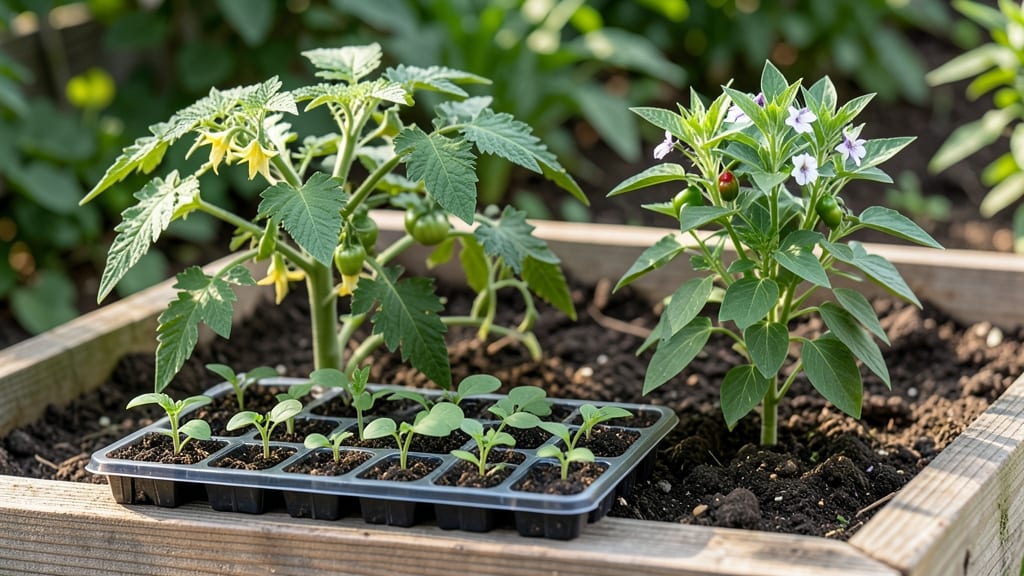
Yes, peppers can be planted with tomatoes but need careful spacing—at least 18-24 inches apart—to avoid nutrient competition, sunlight blockage, and disease spread, particularly fungal issues like early blight. Proper airflow and crop rotation are key.
Peppers and tomatoes share similar growing needs, which makes them compatible neighbors—but only if you plan carefully. 🌱 The real challenge lies in their shared vulnerabilities: both plants are susceptible to the same soil-borne diseases, like verticillium wilt, which thrives in crowded, poorly ventilated conditions.
I’ve seen gardens where peppers stunted growth simply because tomatoes hogged too much sunlight and nutrients, leading to smaller yields and weaker plants. The solution? Strategic spacing and smart companion choices, like interplanting with basil or marigolds, which naturally repel pests and improve airflow between plants.
For best results, consider raised beds or container gardening—these methods give you precise control over spacing and drainage. If you’re planting in-ground, place tomatoes on the north side of peppers to avoid shading them.
And remember: rotating your crops annually prevents disease buildup in the soil, ensuring both plants thrive season after season.
💡 In This Article
- Why Peppers and Tomatoes Shouldn’t Grow Too Close
- Optimal Companion Planting Layouts for Peppers and Tomatoes
Why peppers and tomatoes shouldn’t grow too close
The core issue with planting peppers and tomatoes together lies in their shared vulnerabilities to soil-borne pathogens. Both plants belong to the nightshade family (Solanaceae) and share similar physiological traits that make them susceptible to the same diseases.
For example, verticillium wilt and fusarium wilt thrive in dense planting conditions where airflow is restricted.
These fungal infections enter through the roots, blocking water and nutrient transport, which causes the plant to wilt and die—often within weeks of infection. 🌱 The problem escalates when plants are crowded, as spores spread more easily through splashing water during irrigation.
Nutrient competition is another critical factor. Tomatoes are heavy feeders, especially during fruiting, requiring consistent access to nitrogen, phosphorus, and potassium. Peppers, while slightly less demanding, still need these nutrients to develop their characteristic sweetness and heat levels.
When planted too closely—less than 18 inches apart—the root systems intertwine, creating a fierce battle for resources. This competition manifests as stunted growth, yellowing leaves, and reduced fruit production. In extreme cases, peppers may fail to set fruit entirely, while tomatoes produce smaller, less flavorful fruits.
Sunlight deprivation further compounds the issue. Tomatoes, particularly indeterminate varieties that grow 6-10 feet tall, can cast significant shade over shorter pepper plants (typically 18-36 inches tall).
Peppers need 6-8 hours of direct sunlight daily to ripen properly, but when shaded by tomatoes, they produce fewer peppers and those that form often remain green or develop a bitter taste.
This shading effect is most pronounced in late summer when tomato vines reach their peak height and leaf density.
What most gardeners don’t realize is how moisture dynamics play a role. Crowded plants create a microclimate with high humidity and poor airflow, which is ideal for fungal spores to germinate and spread.
For instance, early blight (caused by Alternaria solani) thrives in these conditions, creating concentric rings on leaves that eventually kill the plant. The disease spreads through water droplets, so overhead watering in dense plantings accelerates its progression.
Even with fungicides, prevention through proper spacing is far more effective and sustainable.
Consider this real-world example: In a 2019 University of Florida study, tomato plants spaced 24 inches apart produced 30% more fruit than those planted 12 inches apart, while pepper yields improved by 25% when given 18 inches of clearance from their tomato neighbors.
The key takeaway? Proper spacing isn’t just about aesthetics—it’s a biological necessity for both plants to reach their full potential.
To mitigate these risks, start by mapping your garden layout before planting. Use stakes or cages for tomatoes to train their growth vertically, freeing up ground space for peppers. Alternatively, plant peppers in container pots placed between tomato rows, ensuring each pepper has its own dedicated soil volume.
This approach not only improves airflow but also makes it easier to monitor and treat individual plants if diseases appear. 💛