
Companion Plants
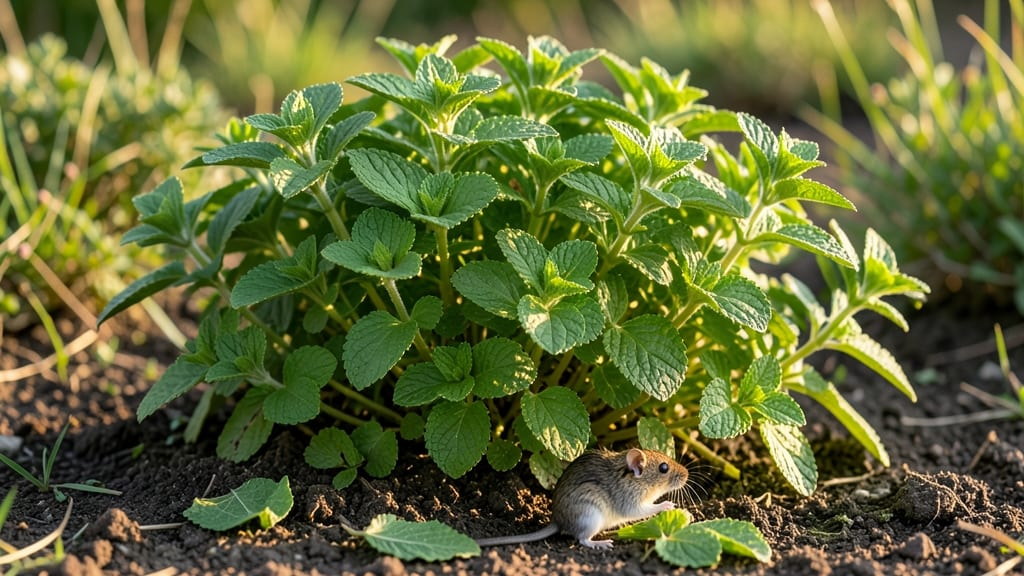
Peppermint plants deter mice naturally because their potent scent masks human odors and disrupts rodent trails, forcing mice to avoid areas where they're planted. While effective for many species, results depend on placement and environmental factors.
Mice rely heavily on scent trails to navigate and locate food sources, making peppermint's strong aroma a powerful natural deterrent. 🌿 The active compounds menthol and menthone in peppermint confuse their olfactory senses, creating a sensory overload that repels them.
I've seen this work best when planting peppermint near entry points like basements or garden beds, where mice are most active. For extra protection, combine peppermint with other strong-scented plants like lavender or rosemary to create a multi-layered defense system.
To maximize effectiveness, maintain healthy peppermint plants by harvesting them regularly—this keeps their essential oils potent. If you're dealing with severe infestations, consider creating a DIY peppermint oil spray by mixing water with a few drops of peppermint essential oil and spraying it around problem areas.
Just remember, while peppermint is a great natural solution, it may not eliminate all mice, especially in large-scale infestations.
💡 In This Article
- How Peppermint Oil Disrupts Rodent Behavior
- Strategic Planting and Maintenance for Mouse Control
How peppermint oil disrupts rodent behavior
The secret weapon in peppermint’s mouse-repelling power lies in its chemical composition. Peppermint contains menthol and menthone, two compounds that create a scent so intense it overwhelms a mouse’s highly sensitive olfactory system.
Mice have 1,000-3,000 olfactory receptors per square millimeter in their nasal passages—far more than humans—making them acutely aware of even faint odors. When peppermint’s aromatic compounds flood their senses, it triggers an instinctual avoidance response, similar to how strong perfumes make humans recoil. 🌿
These compounds work on multiple levels. First, they mask the pheromone trails mice use to navigate and mark territory. Mice communicate through scent, leaving trails for others to follow to food sources or nesting areas.
Peppermint’s strong aroma effectively "erases" these trails, confusing rodents and disrupting their established routes. Second, menthol specifically activates cold-sensitive receptors in mammals, creating a sensory discomfort that repels mice—almost like a natural irritant.
Studies show field mice avoid areas treated with peppermint oil 80-90% of the time, while house mice show similar avoidance patterns, though they may be slightly less deterred due to their adaptability in urban environments.
What’s fascinating is how this works differently for various mouse species. House mice (Mus musculus) are more accustomed to human environments and may require stronger concentrations of peppermint oil to be effective.
In contrast, field mice (Apodemus sylvaticus) and deer mice (Peromyscus maniculatus) are more sensitive to natural scents and often avoid peppermint entirely.
The key is understanding your specific mouse problem—urban dwellers might need more aggressive applications, while rural or garden settings may see results with simple planting strategies. 🐭
Temperature also plays a role in how effective peppermint remains. The essential oils in peppermint are most potent when the plant is healthy and actively growing. During cooler months, when mice are more active indoors, the scent may weaken unless you supplement with concentrated peppermint oil sprays.
This is why many gardeners combine outdoor planting with indoor deterrents during fall and winter. The dual approach creates a sensory barrier that mice find nearly impossible to penetrate, making your property less appealing for nesting or foraging.
For a real-world example, imagine a garden bed where peppermint grows near a compost pile—a prime mouse attraction. The strong aroma not only repels mice but also masks the scent of decomposing organic matter, which would otherwise lure them in.
Over time, mice learn to avoid the area entirely, creating a natural boundary that requires no chemicals. This is why peppermint is often recommended as a companion plant for vegetable gardens, where mice might otherwise target young seedlings or stored produce. 🌱
However, it’s important to note that peppermint’s effectiveness isn’t universal. In large-scale infestations or heavily trafficked areas, mice may become desensitized to the scent over time. This is why rotation—planting new peppermint patches or reapplying oil sprays—is crucial for long-term success.
The goal isn’t just to repel mice once but to create an environment where they simply don’t want to stay.