
Blooming
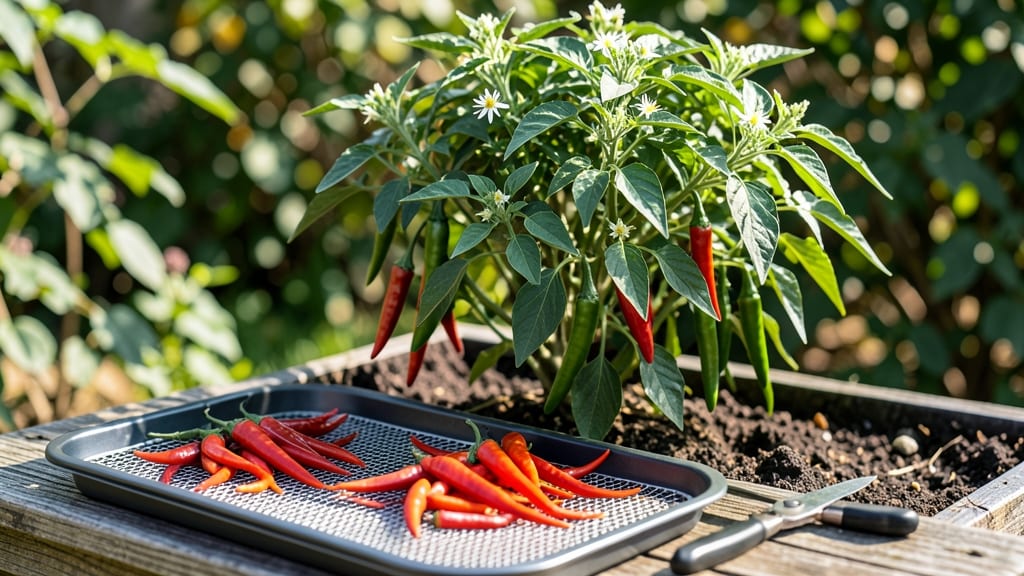
To dehydrate cayenne peppers, plan for 24 to 48 hours at 125–135°F (52–57°C) until they become completely dry, brittle, and free of any moisture. Verify doneness by crushing a pepper—it should crumble without resistance. Once fully dehydrated, preserve them in sealed containers for long-term use.
Dehydrating cayenne peppers at this precise temperature range is key because it gently removes moisture without scorching the peppers' natural oils or heat-sensitive capsaicin. Humidity levels in your kitchen can extend drying time, so I always run my dehydrator with a small fan nearby to maintain consistent airflow. Oven methods work too—just prop the door open slightly—but require closer monitoring to avoid overheating.
The crush test isn't just a final check; it's your quality control moment to ensure every pepper is perfectly preserved. 🔥
Once fully dried, these peppers transform into a potent powder perfect for seasoning dishes or making homemade hot sauce. The brittle texture signals they're ready for grinding, but never rush the process—under-dried peppers will mold faster in storage.
I keep mine in amber glass jars away from light to maintain their fiery potency for up to a year.
💡 In This Article
- Optimal Temperature and Time for Perfectly Dried Cayenne Peppers
- Testing Moisture Levels and Storing Dried Cayenne Peppers
Optimal temperature and time for perfectly dried cayenne peppers
The 125–135°F (52–57°C) range is ideal because it creates the perfect balance between moisture removal and heat sensitivity. At this temperature, the peppers' cell walls break down gradually through a process called osmosis, where water migrates from the pepper's interior to the surface and evaporates.
This gentle heat preserves the capsaicin—the compound responsible for the pepper's heat—while avoiding the thermal degradation that occurs above 140°F (60°C), which can turn the powder bitter or lose potency. 🔥
Humidity plays a critical role in drying time. In environments with 40-50% humidity, peppers typically dry in 24 hours, but if humidity climbs to 60% or higher, drying can stretch to 48 hours or more.
That's why I always use a dehydrator with a built-in fan or place a small household fan nearby when using an oven method. Airflow accelerates evaporation by 20-30%, cutting drying time significantly.
For comparison, a standard kitchen oven without airflow might take 3-4 hours per batch at 170°F (77°C), but with the door propped open.
Dehydrators offer the most consistent results because they maintain steady temperatures and airflow. The Nesco FD-75A model, for example, circulates air at 135°F (57°C) with a fan speed of 120 CFM, ensuring even drying across all pepper trays.
Oven methods require more vigilance—peppers on the top rack dry faster than those on the bottom, so I rotate trays every 2 hours to prevent uneven drying.
The goal is to reach 5-7% moisture content, which is the threshold where peppers become completely brittle and safe for long-term storage. 💫
Temperature fluctuations are your enemy. Even a 10°F (5.5°C) drop can slow evaporation by 30%, extending drying time significantly. That's why I recommend using a food thermometer to monitor internal pepper temperature—it should never exceed 135°F (57°C).
If you're drying in batches, keep the first batch in until completely dry before starting the next to maintain consistent conditions. The science here is about controlling the vapor pressure gradient between the pepper and the surrounding air, which drives moisture out efficiently.
Cayenne peppers contain 8-9% water by weight when fresh, and dehydration removes 95% of that moisture. The remaining 5% is bound water that won't evaporate without cooking. This is why the crush test works—when peppers reach this moisture level, they become so brittle that they shatter like glass.
Under-dried peppers (with 10-15% moisture) will feel leathery and may develop mold within 2-3 weeks of storage, even in airtight containers. 🌟
For those using solar dehydrators, timing depends heavily on climate. In arid desert conditions, peppers may dry in 12-16 hours under direct sun, while humid coastal areas can extend drying to 36-48 hours.
The key is to start dehydration early in the day when temperatures are rising and humidity is lowest. Always place peppers on screens to allow airflow on all sides—this prevents the formation of a moisture barrier that would trap water inside.